
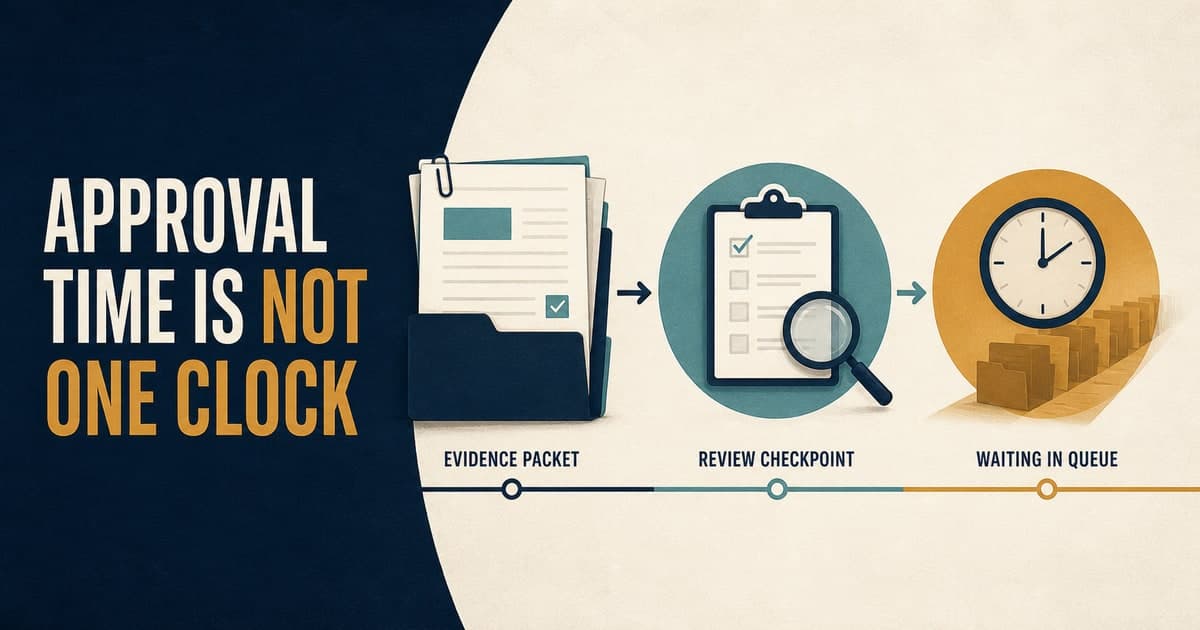
Approval waiting-time measurement
Total elapsed time does not reveal who was working or waiting. A request can wait before assignment, sit in active review, return for information, pause under an authorized hold, and then wait for a recorded decision. The GAO medical-device review tables distinguish agency time, applicant time, total elapsed time, and review-cycle time, providing a useful multi-clock pattern without setting a business approval target.
Use one submitted approval packet as the unit. Record timestamps for received, completeness checked, assigned, review started, information requested, response received, decision recorded, and closed. Each event needs a stable request ID, actor role, reason, and source evidence.
Build clocks from events
Define queue wait as complete-to-assigned time, active review as documented review intervals, requester response as information-request-to-response time, and decision recording as decision-to-closure time. Do not subtract nights or weekends unless a governed calendar was fixed before analysis. Preserve reopened cycles rather than overwriting the first decision.
The GAO drug-review study found that application characteristics and target time frames mattered when comparing review durations. The transferable lesson is to segment known request classes before comparing teams or reviewers. It does not justify applying federal review goals to commercial workflows.
Freeze one cohort by complete-submission date and carry unresolved cases to the study cutoff. Report medians and ranges only when the sample supports them, along with event completeness and censored open items. A closed-only report removes the slowest active cases and can make the process appear faster.
Read the result as a system measure
Show the share of elapsed time assigned to each clock, but retain raw counts and missing-event rates. A long requester interval may reflect a vague request, unavailable evidence, or a legitimate dependency. A long internal queue may reflect capacity, priority policy, specialist access, or missing assignment rules.
The NIST Research Data Framework emphasizes provenance and fitness for purpose, which supports retaining original events and rule versions. The GAO evidence guide likewise supports evidence that is sufficient and appropriate for the conclusion being drawn.
An operations coordinator can maintain event definitions, reconcile evidence, and prepare exception views. The designated approver retains decision authority, while the process owner decides whether to change service expectations or staffing. Our operations support services can maintain the event register, and the Research index offers related study designs.
Sources and limits
- GAO medical-device review time, for distinct review and applicant clocks.
- GAO drug application review, for request characteristics and review-time interpretation.
- GAO generic application cycles, for first-cycle and resubmission evidence.
- GAO approval-process evaluation, for evaluating approval efficiency with contextual evidence.
- GAO evidence guide, for evidence sufficiency and appropriateness.
- NIST process characterization, for defined inputs, outputs, and stable observation.
- NIST Research Data Framework, for provenance and rule documentation.
- NIST information quality standards, for clear, complete, reproducible information.
- Census Statistical Quality Standards, for monitoring, completeness, and documented corrective action.
- Federal internal-control standards, for control activities, information, and monitoring.
These sources support separating clocks and evidence states, not a universal approval deadline. This article is operational research guidance, not legal, regulatory, staffing, or approval advice.