
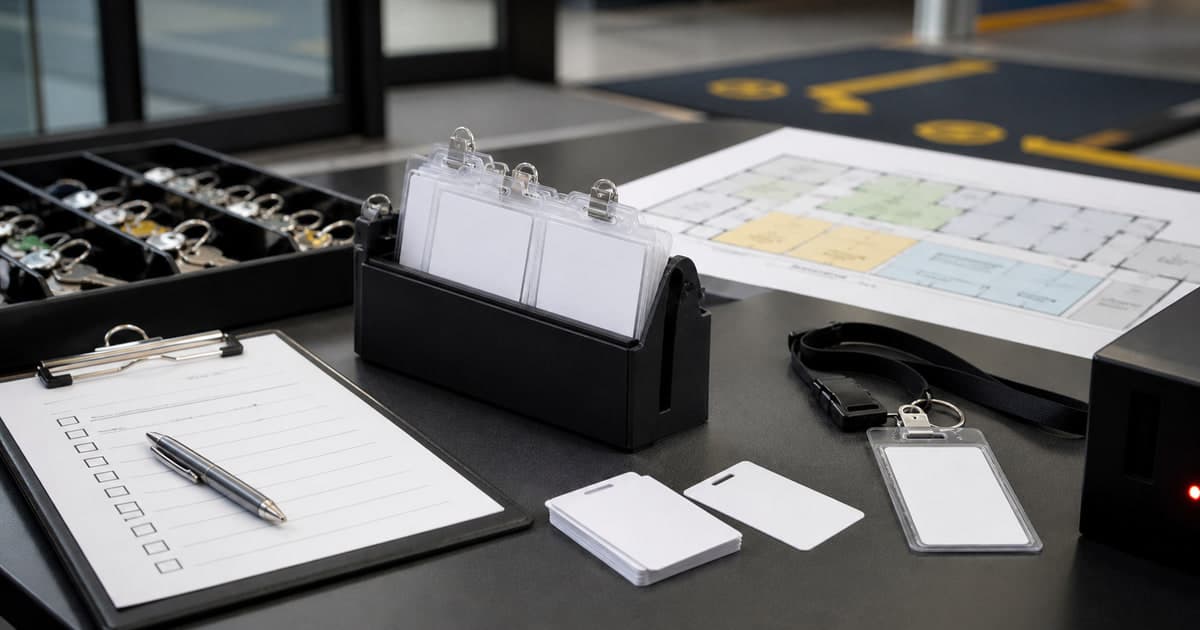
A virtual assistant for facility access requests can run the administrative path from sponsor request to credential return. The assistant validates completeness, obtains decisions, coordinates prerequisites, and records lifecycle events. Security and facility owners decide who may enter, where, when, and under what conditions.
Require a sponsor and a bounded purpose
Every request should identify the person, sponsoring employee or department, business purpose, facility, requested zones, access type, start and end time, recurring pattern if any, and prerequisites. “Vendor needs building access” is not enough to determine whether a lobby badge, escorted plant visit, loading-area entry, or server-room credential is being requested.
Use the least sensitive identifier needed in the coordination record. Government ID images, background reports, and credential secrets belong in approved access-control systems. The tracker can store verification status and a controlled reference.
NIST Special Publication 800-53 includes a control family for physical and environmental protection, including physical access authorizations and controls. That publication addresses federal information systems and organizations, not a universal visitor-badge procedure. It supports assigning access decisions to accountable control owners while local policy governs each request here.
Route by zone and access mode
Create a matrix maintained by security: public reception, staff area, warehouse, roof, plant room, records area, data room, or other site-specific zones. Map each zone and access mode to the authorizer, escort rule, training, safety briefing, working hours, and credential type.
For example, a copier technician may need an unescorted office badge for two hours but no access to records storage. A roofing surveyor may need an escort, fall-protection prerequisites, and a facilities permit. The coordinator applies the matrix and gathers evidence. They do not decide that a familiar vendor can skip a condition.
If requested zones conflict with the stated purpose, return the discrepancy to the sponsor. Preserve the requested scope and the approved scope separately so later reviewers can see what changed.
Coordinate the visit as an arrival sequence
Before the start time, confirm the authorization, identity-verification path, sponsor or escort availability, required induction, parking or loading instructions, prohibited items, emergency contact, and credential issue point. Send the visitor only information they are authorized to receive.
At arrival, the approved operator verifies identity and issues the credential. The assistant may monitor that the event was recorded but should not ask staff to bypass verification because the sponsor is delayed. If prerequisites fail, use the security owner's hold and escalation path.
Temporary credentials need automatic or monitored expiry. A badge that merely has “Thursday” written on a note is not a reliable time boundary. Record issue, activation, expiry, return, disablement, and any lost credential event against the request ID.
Finish with revocation, not departure alone
When the visit ends, reconcile the credential and access state. If a badge is not returned, notify security immediately under the local rule. If the engagement extends, obtain a new or amended authorization rather than editing the expiry without a decision.
Recurring access deserves periodic sponsor and scope review. Employment change, contract completion, zone change, lost device, security event, or extended inactivity can trigger early review. The coordinator raises the event; security chooses the response.
Audit the full lifecycle
Sample active credentials against unexpired sponsors and approved zones. Review access granted before prerequisites, credentials active after end time, lost badges routed late, and broad zones approved for narrow purposes. Track how often incomplete requests delay visits so sponsors can improve inputs.
Can the assistant approve a low-risk visitor? Only if policy expressly delegates that decision and defines the evidence. In most cases, the role should coordinate a named owner's approval.
What is the key closure check? Confirm that the credential is returned or disabled and that any exception has reached security. A visitor signing out does not by itself revoke electronic access.